
Next-Gen Semiconductor 2026: Complete Guide to Future Chip Technology
Updated: May 14
Table of content
What are semiconductors and why do they matter?
A semiconductor is a material, usually silicon, that controls how electricity moves. In simple terms, it can switch electrical flow on or off, or regulate how much passes through. That control is what makes semiconductors the building blocks of every modern computer chip. These chips run everything from wireless earbuds to satellites in orbit.
Think of a chip like the brain of a device. Without it, our phone is just a shiny piece of glass. The chip is what makes it think, respond, and connect.
As devices become more powerful and software becomes more demanding, the need for faster, smarter, and more energy-efficient chips keeps rising. That is where next-generation semiconductor technology comes in.

Where are we right now?
As of 2026, the most advanced chips are being manufactured at 2-nanometer (nm) and 3nm process nodes. For comparison, a single strand of human hair is about 80,000 nanometers wide. Today, manufacturers can fit billions of transistors — tiny switches that manage electrical signals — onto a chip small enough to sit on your fingertip.
2nm Current chip size (2026) | $600B+ Global semiconductor market | 50B+ Transistors per chip | 3x AI chip demand growth (2024-26) |
Companies like TSMC, Intel, and Samsung are racing to produce chips that are faster, smaller, and cheaper.
What is a next-gen semiconductor?
A next-generation semiconductor is not just a smaller version of today's chip. It is a completely rethought design — using new materials, new structures, and sometimes entirely new physics.
The aim is straightforward: improve performance, reduce energy use, and lower production costs. Getting there, however, requires some of the most advanced science and engineering work happening today.
Key Technologies shaping the future
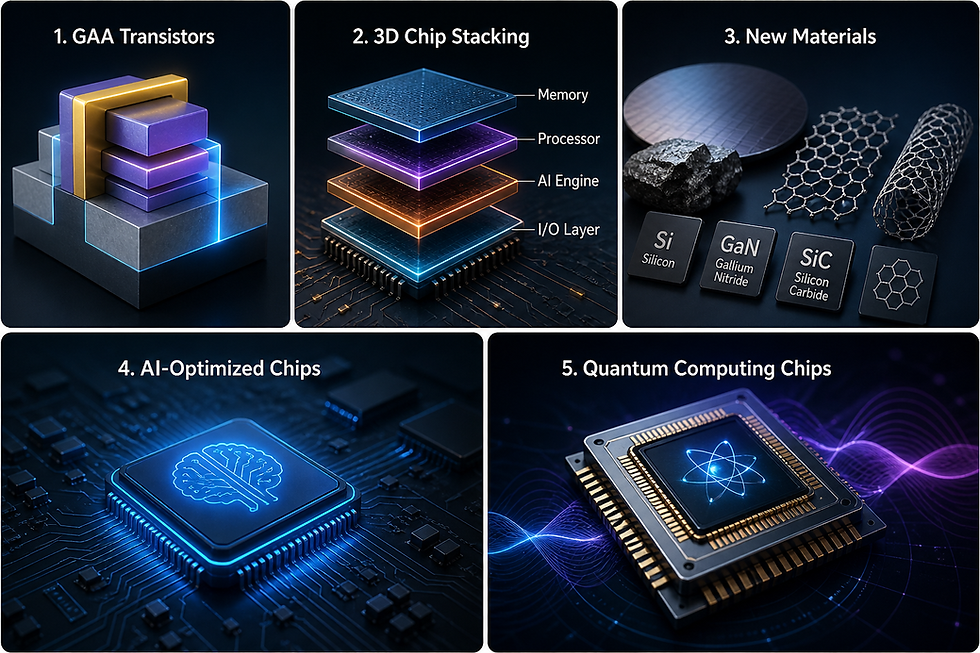
Gate-All-Around (GAA) Transistors
Conventional transistor designs are approaching their limits. GAA transistors improve control by surrounding the silicon channel with the gate. This gives engineers better precision and efficiency. Samsung started mass-producing GAA chips in 2022, and other manufacturers are moving in the same direction.
3D Chip Stacking
Instead of making chips wider or thinner, engineers are now stacking chips on top of each other like floors in a building. This is called 3D integration or chiplet architecture. It allows different components — memory, processor, AI engine — to sit closer together, which means faster communication and less energy lost.
New Materials Beyond Silicon
Silicon has been the standard for decades, but it is no longer the only serious option. Materials such as gallium nitride (GaN) and silicon carbide (SiC) are already being used in power electronics. At the same time, researchers are exploring graphene and carbon nanotubes for future high-speed computing applications.
AI-Optimized Chips
Artificial intelligence workloads need different hardware from traditional computing tasks. Standard processors are designed for general-purpose use, while AI chips are built to perform many calculations in parallel. That is why products like Google’s TPUs and Nvidia’s H-series GPUs have become so important. By 2026, nearly every major tech company will be investing in custom AI silicon.
Quantum Computing Chips
Quantum chips are still in an early stage, but they could eventually solve problems that are far beyond the reach of classical computers. Companies including IBM, Google, and IonQ are continuing to push the field forward. If progress holds, practical quantum systems could reshape areas such as drug discovery, finance, and cryptography over the next decade.
Who is leading the semiconductor race?
The semiconductor industry is not just a tech race — it is a geopolitical one. Countries are treating chip manufacturing as a matter of national security.
TSMC (Taiwan) — Produces nearly 90% of the world's most advanced chips. The entire global tech industry — including Apple, Nvidia, and AMD — depends on it.
Intel (USA) is rebuilding its manufacturing capabilities with massive government support under the US CHIPS Act.
Samsung (South Korea) — Is competing at the frontier with its own foundry operations.
China is investing billions to build a self-sufficient chip industry, though it still lags in cutting-edge production.
India — With new fab investments announced in 2024 and 2025, it is positioning itself as a future player in chip design and packaging.
How will this affect everyday life?
Better chips do not just make phones faster. They influence a wide range of technologies people use every day.
Healthcare — Smarter chips enable real-time health monitoring, faster medical imaging, and AI-powered diagnosis tools that doctors can use anywhere.
Electric Vehicles — Next-gen chips manage battery performance, self-driving features, and energy efficiency in EVs, making them safer and cheaper.
Climate & Energy — More efficient chips use less electricity, which means less carbon. Power grid optimization using AI chips can reduce waste across entire cities.
Education & Work — Faster, cheaper computing puts powerful tools in the hands of students and small businesses worldwide, including across developing economies.
Challenges ahead
The industry still faces major obstacles in 2026.
Manufacturing at 2nm and below depends on extreme ultraviolet (EUV) lithography machines, and ASML in the Netherlands is the only company that makes them. Each system costs more than $150 million. On top of that, supply chains for materials such as tantalum, cobalt, and rare earth elements remain vulnerable and politically sensitive.
There is also a talent shortage. Designing, building, and operating semiconductor fabs requires highly specialized expertise, and global demand for that talent is still greater than supply. Universities and governments are trying to close the gap through training programs, partnerships, and incentives.
Conclusion
We are living through a major turning point in technology. The chips being developed today will shape the AI systems, electric vehicles, medical tools, and communication networks of the next two decades.
Next-gen semiconductors are not just a story about technology — they are a story about the future of human progress. Every breakthrough in chip design means better healthcare, cleaner energy, smarter cities, and more opportunities for people around the world. Understanding semiconductors, even at a basic level, gives you a clearer picture of the world being built around you.
Frequently asked questions (FAQ)
Q1: What is a nanometer, and why does chip size matter?
A nanometer is one-billionth of a meter. In semiconductors, it refers to the manufacturing node associated with a chip generation. Smaller nodes generally allow more transistors to fit into the same area, which can improve speed and power efficiency. So, moving from 5nm to 2nm is not a minor change; it can significantly improve computing performance and energy use.
Q2: Will quantum computers replace regular computers?
Not anytime soon for everyday tasks. Quantum computers are extremely powerful for specific types of problems — like simulating molecules for drug discovery or breaking encryption codes. But they are not practical for browsing the internet, watching videos, or writing emails. Think of them as a specialized tool, not a replacement for your laptop.
Q3: Why does chip manufacturing happen mostly in Asia, and is that a problem?
Most advanced chip manufacturing is concentrated in Taiwan, South Korea, and Japan because these regions have built expertise, infrastructure, and supply chains over decades. The concern is that any political instability or natural disaster in these areas could disrupt the entire global tech industry. That is why the US, Europe, and India are now investing heavily to build their own chip fabs.
Q4: How can I start a career in the semiconductor industry?
A strong background in physics, electrical engineering, materials science, or computer engineering is a good starting point. Many universities now offer semiconductor-focused programs, and internships at companies such as TSMC, Intel, Qualcomm, or ISRO-linked labs in India can provide valuable experience. It is a fast-growing field, and demand for skilled professionals remains very high.


Nice and easy content with a simple writing style. It is clear and easy to read. I also use a CPS Test to improve my clicking speed. Practicing daily is helping me build better control and steady performance.