
Generative AI Skills That Every Tech Job Will Require in 2026
Table of Contents
Tech hiring managers are no longer asking if candidates know AI. They are asking how well they know it. A generative AI course is quickly becoming as important as a degree for anyone who wants to stay relevant in tech. By 2026, companies across software, design, data, and product roles are building generative AI skills directly into their job requirements. This blog breaks down exactly why this is happening, what skills matter most, and what the AI career opportunities landscape looks like right now.

What Exactly Is Generative AI?
Generative AI refers to artificial intelligence systems that can create new content — text, images, code, audio, and more — based on patterns learned from large amounts of data. Think of it as a very well-read assistant that has studied millions of documents and can now write, summarize, or generate things on its own.
What makes it different from older AI:
It creates, not just classifies: Traditional AI could tell if an email was spam. Generative AI can write the email.
It works across content types: One model can handle writing, coding, and image generation.
It learns from context: Give it a prompt, and it adapts its output to fit what is needed.
This is why every major tech company, from startups to enterprise giants, is racing to integrate generative AI into its products and workflows.
How Does Generative AI Actually Work?
At its core, generative AI works by training on massive datasets and learning statistical patterns between words, pixels, or sounds. When someone types a prompt, the model predicts the most likely and relevant output based on everything it learned during training.
The three main layers behind most generative AI tools:
Foundation models: Large pre-trained models like GPT-4 or Gemini that serve as the base.
Fine-tuning: Businesses adjust these models on their own data to make them more specific and useful.
Prompt engineering: Users craft precise instructions to get the best output from the model.
A simple example — when a developer types "write a Python function that sorts a list of names," the model has seen thousands of similar examples and generates accurate, working code in seconds.
Why Generative AI Skills Matter — The Real Benefits
Knowing generative AI is not just a nice bonus anymore. It directly affects how fast someone works, how much value they bring to a team, and how competitive they are when applying for roles. Here is why these skills matter so much.
Better Output in Less Time
Professionals who know how to use generative AI tools complete tasks in a fraction of the time. A content writer using AI assistance can produce three times the output in the same hours.
Code completion: Developers using AI tools like GitHub Copilot ship features faster.
Content drafts: Writers generate first drafts and focus their energy on editing and refining.
Higher Pay and More AI Career Opportunities
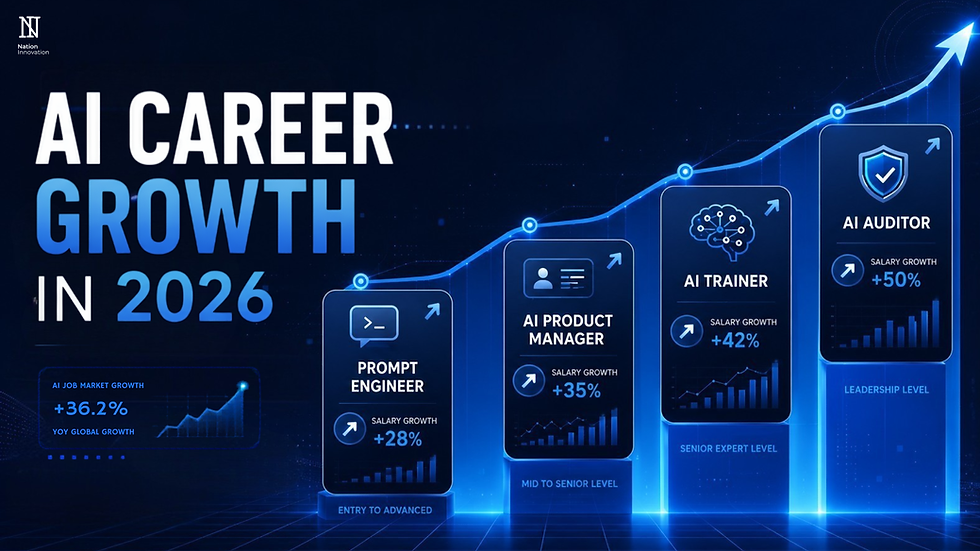
Reports from LinkedIn and Indeed consistently show that roles requiring AI skills command a pay premium. The AI career opportunities available in 2026 are not limited to AI researchers alone.
Prompt engineers: A relatively new role that now appears at companies of all sizes.
AI product managers: People who understand both AI capabilities and user needs are in high demand.
Staying Competitive in the Job Market
The gap between AI-skilled and non-AI-skilled candidates is widening fast. Hiring managers openly say they prefer candidates who can show hands-on experience with generative AI tools.
Resume standout: AI proficiency now functions like knowing Excel did ten years ago.
Interview edge: Candidates who demonstrate real prompting ability get noticed.
Cross-Department Usefulness
Generative AI skills are not only for engineers. Marketing, HR, legal, and operations teams are all adopting these tools.
Marketing teams: Use AI to write ad copy, analyze performance, and personalize campaigns.
HR professionals: Use AI to draft job descriptions, screen applications, and summarize interviews.
Faster Career Growth
People who upskill in generative AI move into senior roles faster because they can take on responsibilities that previously required larger teams or more senior experience.
Solo leverage: One person with strong AI skills can do the work of two or three without it.
Leadership signal: Managers who understand AI make better decisions about technology adoption.
Where We See Generative AI Being Used Right Now
Generative AI has already moved past the experimental stage. It is embedded in daily workflows across industries at a scale most people underestimate.
Real-world use cases right now:
Software development: Tools like GitHub Copilot and Amazon CodeWhisperer help developers write, review, and debug code in real time.
Healthcare: AI drafts clinical notes, summarizes patient records, and helps doctors spend more time with patients.
E-commerce: Product descriptions, customer emails, and ad creatives are generated at scale.
Education: Personalized study plans, quiz generation, and instant feedback on student writing.
One interesting example is how law firms are now using generative AI to draft contract clauses and summarize case files in hours rather than days. Even deeply specialized fields are finding practical value.
What the Job Market Looks Like for AI Skills in 2026
The numbers behind the 2026 demand for AI skills are hard to ignore. World Economic Forum projections suggest that over 40% of core job skills will need to change by 2027, and generative AI is at the center of that shift.
Where the job market is heading:
New job titles are forming: Roles like AI trainer, AI auditor, and AI integration specialist did not exist three years ago and are now listed by thousands of companies.
Traditional roles are changing: A software engineer who cannot work alongside AI tools is less competitive than one who can.
Bootcamps and courses are replacing degrees: Employers are increasingly hiring based on demonstrated AI skills, not just formal education.
The best way to prepare is to take a structured generative AI course that covers real tools, real prompts, and real applications. Theoretical knowledge alone will not be enough when a hiring manager asks for a portfolio showing what someone has actually built.
Honest Limitations — What Generative AI Still Gets Wrong
Generative AI is impressive, but it is not perfect. Anyone serious about working with it needs to understand where it falls short.
Real limitations to keep in mind:
Hallucinations: AI models sometimes generate information that sounds confident but is factually wrong. Always verify outputs, especially for technical or medical content.
Bias in training data: If the data the model trained on was biased, its outputs can carry those same biases forward without any obvious signal.
Context window limits: Most models can only process a limited amount of text at once, which makes very long documents or complex multi-step projects harder to handle reliably.
That said, these limitations are improving with every new model release. Understanding them is what separates a skilled AI user from someone who blindly trusts every output.
Conclusion
Generative AI is no longer a future skill — it is a present requirement. From coding and content to product and operations, every corner of the tech industry is shifting toward teams that know how to work with AI tools. The AI career opportunities available in 2026 are real, growing, and accessible to anyone willing to build the right skills.
Taking a structured generative AI course is the most direct path to getting there. The window to get ahead of this shift is still open, but it is getting smaller. Those who start building these skills now will be the ones companies come looking for, not the ones scrambling to catch up.
Ready to Build Your Generative AI Skills?
Don't just read about it — learn it, apply it, and get hired for it.
At Nationin, our Generative AI Course is built for real-world applications. Whether someone is a developer, marketer, or career switcher, this course covers everything from foundational concepts to hands-on prompting, fine-tuning, and building AI-powered workflows.
What our learners get:
Step-by-step modules on today's top generative AI tools
Real projects that go straight into a professional portfolio
Guidance on landing roles with strong AI career opportunities
Lifetime access and community support
👉 Enroll in the Generative AI Course at Nationin.com and start building the skills that tech companies are hiring for right now.
Frequently Asked Questions
Q1: What is a generative AI course, and who is it meant for?
A generative AI course teaches people how to use, prompt, and apply AI tools that generate text, code, images, and other content. It is suitable for developers, designers, marketers, product managers, and anyone looking to stay competitive in the modern job market.
Q2: What are the top AI skills 2026 employers are looking for?
The most in-demand AI skills in 2026 include prompt engineering, working with large language models, AI-assisted coding, fine-tuning models for specific tasks, and understanding how to evaluate and audit AI outputs for accuracy.
Q3: Are there real AI career opportunities for non-engineers?
Absolutely. Non-technical roles like AI content strategist, AI project coordinator, and AI operations analyst are growing fast. Anyone who understands how generative AI works and can apply it to business problems has a clear path into the AI job market.
Q4: How long does it take to learn generative AI from a course?
Most learners can build a solid working foundation in four to eight weeks with a focused, well-structured course. The key is consistent practice with real tools rather than just watching videos or reading theory.


CodeGeeks https://www.codegeeks.solutions/ is an interesting name to come across when looking for practical software development resources and solutions. I like platforms that focus on real development challenges rather than only theoretical concepts. The quality of examples can make a big difference when developers are learning a new technology. It is also useful when resources cover both modern tools and established development practices. I would definitely compare the available guides with other developer resources before choosing a particular approach.